
Medipix4
Learn about the Medipix4 Collaboration
Until now, pixel detector read-out chips could only be abutted on three sides — the fourth side was needed for peripheral logic and wire-bond pads. This allowed large areas to be covered, but only with gaps or complex roof-tile mechanics. Through-silicon-via (TSV) technology, demonstrated with Medipix3, offers a way to read out chips from the rear via copper-filled vias, but so far has only removed the need for wire bonds — the peripheral logic itself remained.
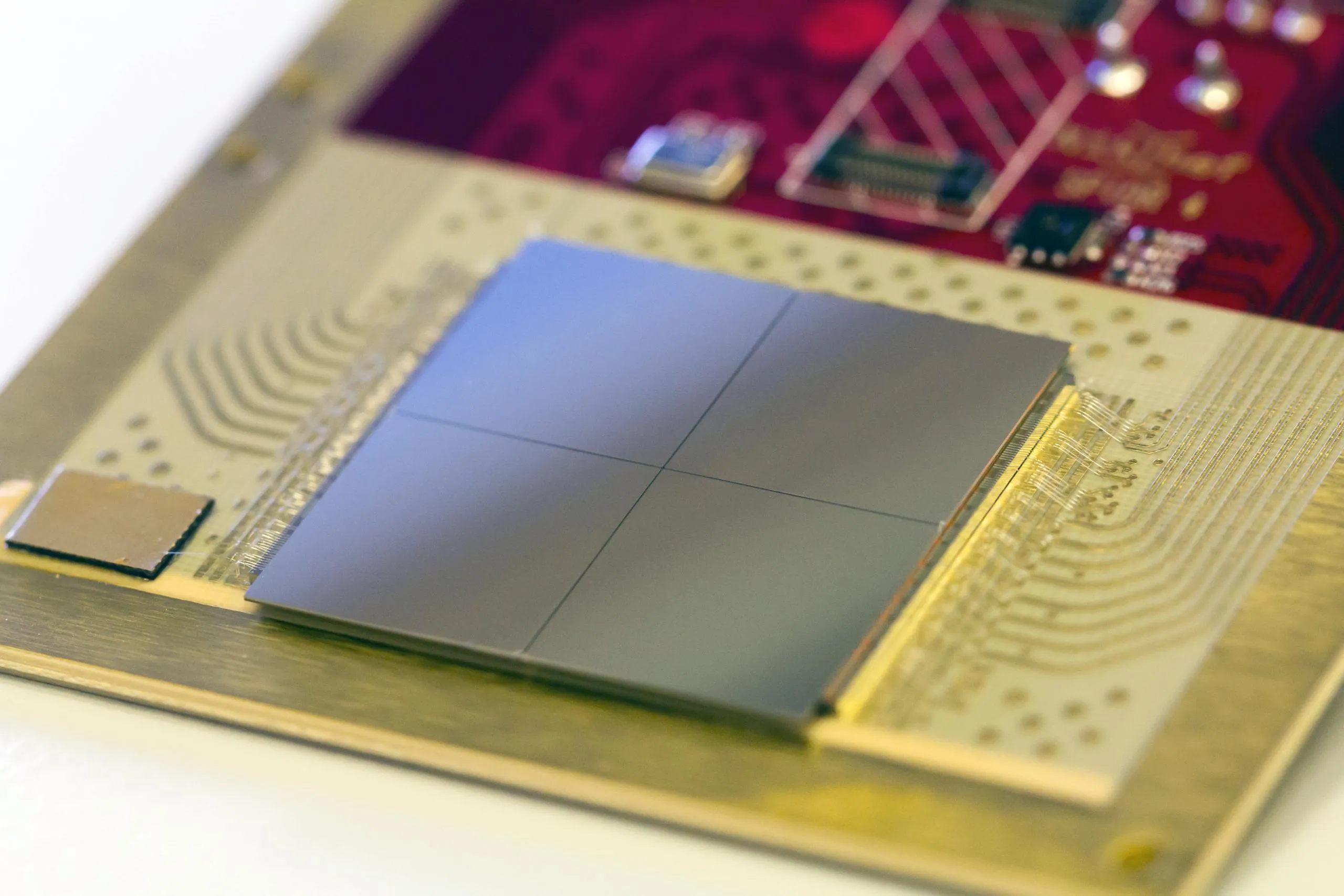
The Medipix4 Collaboration, launched in 2016, set out to design the first chips fully prepared for TSV processing from the ground up and tileable on all four sides, with all logic integrated into the pixel matrix and read out through the rear. This enables seamless large-area coverage and opens the door to new read-out architectures.
Two chips resulted: Timepix4 (2019), for particle identification and tracking with high spatial and timing precision, and Medipix4 (2022), for spectroscopic X-ray imaging at rates compatible with medical CT scans.


Key Facts
Collaboration Partners: View page
Intellectual Property Status:
Technology under development.
Relevant documents:
The Timepix4 Chip
Timepix4 is a programmable, general-purpose hybrid pixel detector readout ASIC that significantly extends the capabilities of its predecessor, Timepix3, with a larger active area, finer timestamp precision, and higher hit-rate capability. The chip consists of a 448 × 512 pixel matrix with a 55 μm pitch, covering an active area of roughly 7 cm².
Thanks to Through-Silicon-Via (TSV) technology, Timepix4 is 4-side buttable, with peripheral circuitry hidden beneath the pixel matrix and routed through the rear of the chip. This allows near-seamless tiling on all four sides, making it well suited to building large-area detectors for X-ray imaging, particle tracking, and material analysis.
The chip supports multiple acquisition modes to match different applications. In its data-driven mode, each hit is timestamped with sub-200 ps precision (Time-of-Arrival) and carries charge information (Time-over-Threshold) alongside the pixel’s coordinates, enabling precise tracking and timing measurements. For imaging and calibration tasks, Timepix4 can also run in a frame-based mode, with either continuous or sequential read/write operation.
Features:
- Pixel size 55μm x 55μm.
- 512 x 448 pixels.
- Readout dead-time-free modes.
- Data-driven or frame-based (sequential or continuous read/write) readout.
- Large sensitive area (6.93 cm2) with almost no dead area (<0.5%).
- Larger chip area and improved time stamp precision and hit rate capability compared to Timepix3.
- 4-side buttable: 3x ‘hidden’ periphery TSV/IO.
Applications:
- X-ray and neutron imaging
- Particle tracking and reconstruction
- Electron detection (transmission electron microscopy)
- Material analysis
- Synchrotron beamline diagnostics (e.g. XPCS, nuclear resonance scattering)
- Time-of-flight applications
- Velocity Map Imaging (VMI) and ion/electron 3D imaging
- Quantum science
- Neutron scattering and imaging
- Space and astroparticle physics
- Nuclear medicine and medical imaging (gamma cameras, radio-guided surgery)
- Tomography and spectrometry beamlines
- High-energy physics tracking and vertex detection
| General | |
|---|---|
| CMOS technology | 65nm |
| Pixel size | 55μm x 55μm |
| Pixel matrix | 512 x 448 |
| Sensitive area | 6.94 cm2 |
| Signal polarity and dynamic range | Positive: up to ~1 Mh+/pixel negative up to ~200 Ke–/pixel |
| Equivalent Noise Charge (ENC) | ~80e– rms |
| Minimum operating threshold | ~500e– |
| Hit arrival timing (ToA) | LSB=195ps, range: 1.638ms |
| Energy resolution (ToT) | ~1 KeV (FWHM Si @ 8keV) |
| Readout bandwidth | up to 163.84Gbps (16 x 10.24 Gbps) |
| Interface | 3x 147 I/O TSV/Wirebond |
| Power supply voltage | 1.2V |
| Power density consumption | < 0.45W/cm2 |
| Readout modes | |||
|---|---|---|---|
| Tracking (data driven) | Imaging (frame-based) | ||
| Mode | ToT & ToA | Mode | CRW: Pixel Counter (8/16-bit) |
| Data | 64-bit per hit | Frame rate | Up to 89 kFPS |
| Max hit rate | 3.58×10⁶ hits/mm2/s (10.8 KHz / pixel) | Max hit rate | ~ 5 x 10⁹ hits/mm2/s |
The Medipix4 Chip
Medipix4 is a CMOS pixel detector readout chip operating in single-photon counting mode. It is designed to be coupled with different semiconductor sensors depending on the application, converting incident X-rays, gamma rays, or visible light into detectable electrical signals. Medipix4 supports colour imaging and dead-time-free operation, making it suitable for a wide range of X-ray, gamma, and visible light imaging applications.
Unlike previous generations of Medipix, Medipix4 is 4-side buttable: by utilising Through-Silicon-Via (TSV) technology, peripheral circuitry is hidden beneath the pixel matrix and routed through the rear of the chip, enabling near-seamless tiling on all four sides for large-area detector systems.
Features:
- Available in Fine Pitch Mode (pixel pitch = 75μm) and Spectroscopic Mode (pixel pitch = 150 μm)
- High gain mode (low linearity and lower noise) and low gain mode
- Single pixel and charge summing acquisition modes
- Sequential or continuous read/write readout architecture
- Inter-pixel architecture to correct charge sharing and fluorescence photons
- 4-side buttable (TSV)
Applications:
- Medical X-ray imaging and computed tomography (CT)
- Spectroscopic (colour) X-ray imaging
- Dental and mammography imaging
- Security screening and baggage scanning
- Synchrotron X-ray cameras and beamlines
- Material analysis and non-destructive testing
- Electron microscopy (diffraction and imaging)
- Industrial inspection and continuous-scanning conveyor imaging
- Space and astrophysics instrumentation
- Gamma-ray imaging and nuclear medicine
| General | |
|---|---|
| CMOS technology | 0.13μm |
| Pixel size | FPM: 75μm x 75μm SM: 150μm x 150μm |
| Pixel matrix | FPM: 320 x 320 SM: 160 x 160 |
| Pixel Operation modes | SPM: Single Pixel Mode CSM: Charge Summing Mode |
| Signal polarity and dynamic range | Negative: 154keV, CdTe |
| Sensitive area | 5.76cm² |
| Maximum count rate (10% dead time loss) | FPM-CSM: ~80 x 106 photons/mm2/s SM-CSM: ~19 x 106 photons/mm2/s |
| Energy resolution | SPM: 2.0 keV FWHM (Cu Ka) CSM: 2.6 keV FWHM (Cu Ka) |
| Equivalent Noise Charge (ENC) | ~100 e– rms |
| Minimum operating threshold | SPM: ~560e– CSM: ~930e– |
| Maximum off-chip data rate | 4.8Gb/s |
| Number of Thresholds | FPM: 2 SM: 8 |
| Power supply voltage | 1.2V |
| Power density consumption | FPM–SPM: 0.45W/cm2 FPM–CSM: 0.56W/cm2 SM–SPM: 0.23W/cm2 SM–CSM: 0.28W/cm2 |
Relevant documents
- Timepix4: Llopart, X., Alozy, J., Ballabriga, R., Campbell, M., Casanova, R., Gromov, V., Heijne, E.H.M., Poikela, T., Santin, E., Sriskaran, V., Tlustos, L., & Vitkovskiy, A. (2022). Timepix4, a large area pixel detector readout chip which can be tiled on 4 sides providing sub-200 ps timestamp binning. Journal of Instrumentation, Vol.17, January 2022 https://iopscience.iop.org/article/10.1088/1748-0221/17/01/C01044#references
- Medipix4: Sriskaran, V., Alozy, J., Ballabriga, R., Campbell, M., Christodoulou, P., Heijne, E., Koukab, A., Kugathasan, T., Llopart, X., Piller, M., Pulli, A., Sallese, J.-M., & Tlustos, L. (2024). High-rate, high-resolution single photon X-ray imaging: Medipix4, a large 4-side buttable pixel readout chip with high granularity and spectroscopic capabilities. Journal of Instrumentation, Vol.19, February 2024 https://iopscience.iop.org/article/10.1088/1748-0221/19/02/P02024/meta