
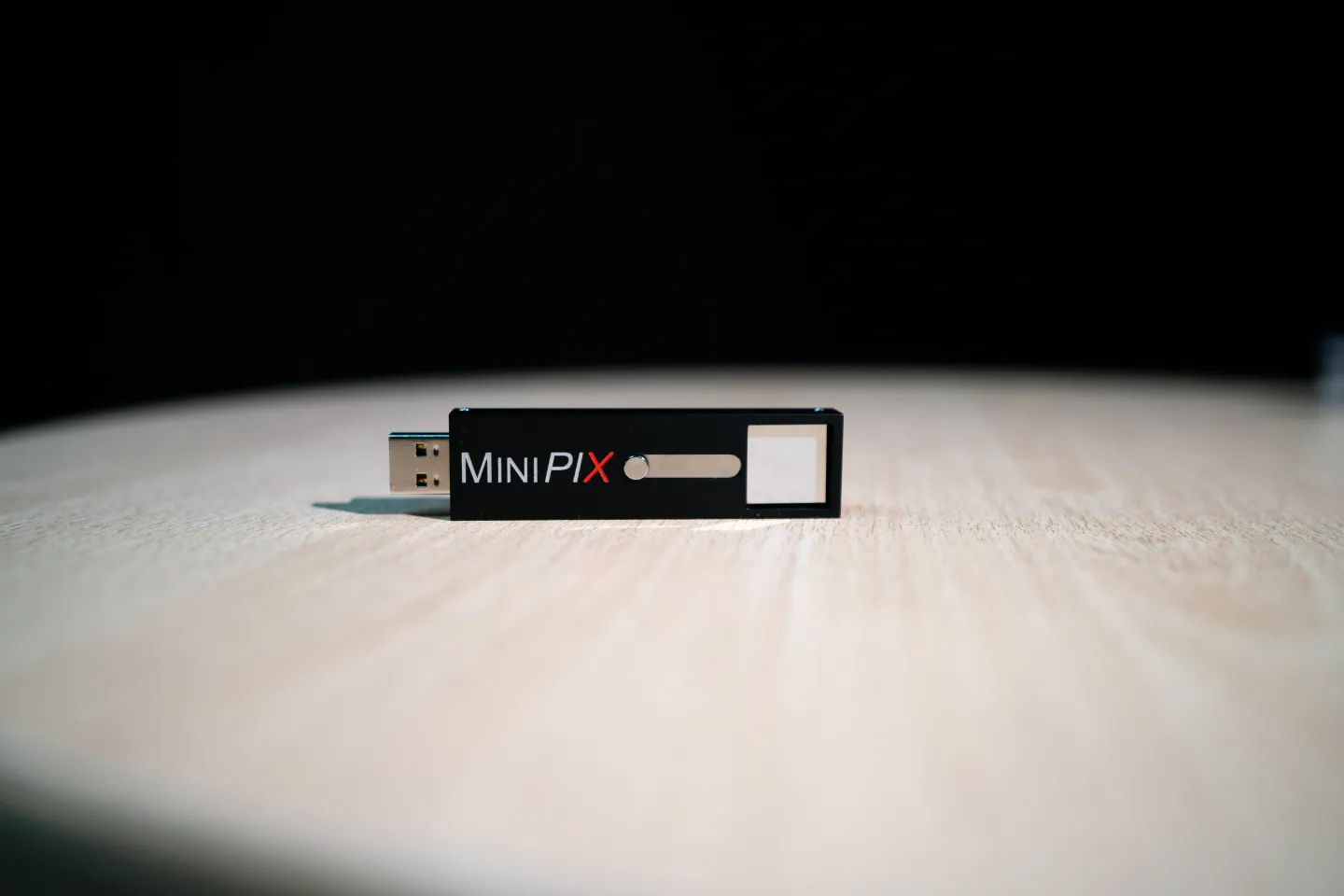
Since their inception at CERN in the framework of the Medipix collaborations, the Medipix and Timepix families of chips have proved their worth in various technical and scientific fields, from medical imaging to astrophysics – Timepix chips are flying on the Artemis I mission this month. Yet, in parallel, these extremely compact and highly accurate particle detectors are infiltrating a more ordinary environment: secondary school classrooms.
CERN microelectronics experts, secondary school teachers in Catalonia and researchers at the University of Barcelona have teamed up to facilitate the dissemination of Minipix detectors (a commercially available USB readout system incorporating the Timepix chip) in Spanish secondary schools, while similar initiatives are flourishing in other European countries too. The project team has established a network of schools that share Minipix detector systems and prepared classroom activities to help teachers maximise the chips’ educational potential.
With nothing more than the Minipix detector and a computer, background radiation can be visualised in real time and perfectly safely. Different naturally occurring particle species (alphas, betas, gammas and cosmic muons) can be distinguished by the characteristic traces they leave in the detector. Experimenting with the device can help pupils attain their educational goals in physics and technology, of course, but also in biology, computer science and mathematics, as laid out in the document presenting the project to the Spanish National Centre for Particle, Astroparticle and Nuclear Physics (Centro Nacional de Física de Partículas, Astropartículas y Nuclear, CPAN).
The initiative was granted an outreach award by a panel of CPAN judges on 25 November. Daniel Parcerisas (Sagrada Familia, Gava) accepted the award at the CPAN 2022 annual meeting in Bilbao, Spain, on behalf of the awarded team, composed of Rafael Ballabriga (EP-ESE-ME, CERN), Eugeni Graugés (University of Barcelona), Anna Argudo (University of Barcelona), David Corrons (La Salle Manlleu), Iolanda Huguet (INS Mollerusa IV), Esther Pallares (University of Barcelona), Hernan Pino (Institut Sant Nicolau, LIWU), Francesc Salvat (SY-STI-BMI, CERN) and Sonia Tarancon (Santo Angel).
The jury rewarded the project’s originality and didactic potential and underlined the efforts made by the team to adapt the experiments to students with special educational needs. The award, besides providing further financial support, bolsters the project and similar initiatives throughout Europe, showcasing the role that institutions such as CERN can play in improving the way physics is taught in schools.
_____________
If you are interested in gaining access to the hybrid pixel detector technology on which the Timepix photon detectors are based, please contact CERN’s Knowledge Transfer group.
CERN’s engineers, technicians and scientists develop novel technologies and expertise contributing to applications in fields beyond high-energy physics, addressing global societal challenges in areas such as aerospace. Find out more about aerospace applications of CERN technologies here.
Also On Timepix
-

Specifications
-
Outreach award for initiative to teach high-school physics with CERN detectors in Spain
Since their inception at CERN in the framework of the Medipix collaborations, the Medipix and Timepix families of chips have proved their worth in various technical and scientific fields, from medical imaging to astrophysics – Timepix chips are flying on the Artemis I mission this month. Yet, in parallel, these extremely compact and highly accurate…
-
Source: CERN (CDS) Timepix: from CERN’s galleries to the Moon
The renowned Timepix detector celebrates its 10-year anniversary on the International Space Station by flying to the Moon: the chip features in NASA’s future lunar programme BROKEN IMAGE NOT MOVED (drupal url : https://medipix.web.cern.ch//news/news/timepix/timepix-cerns-galleries-moon) In July 1969, just a few days after the first Moon landing, CERN’s then Director-General, Bernard Gregory, sent the following message…
-
Specifications
-
Features and Applications
Features: Applications:
-
CERN technology helps rediscover lost painting by Raphael
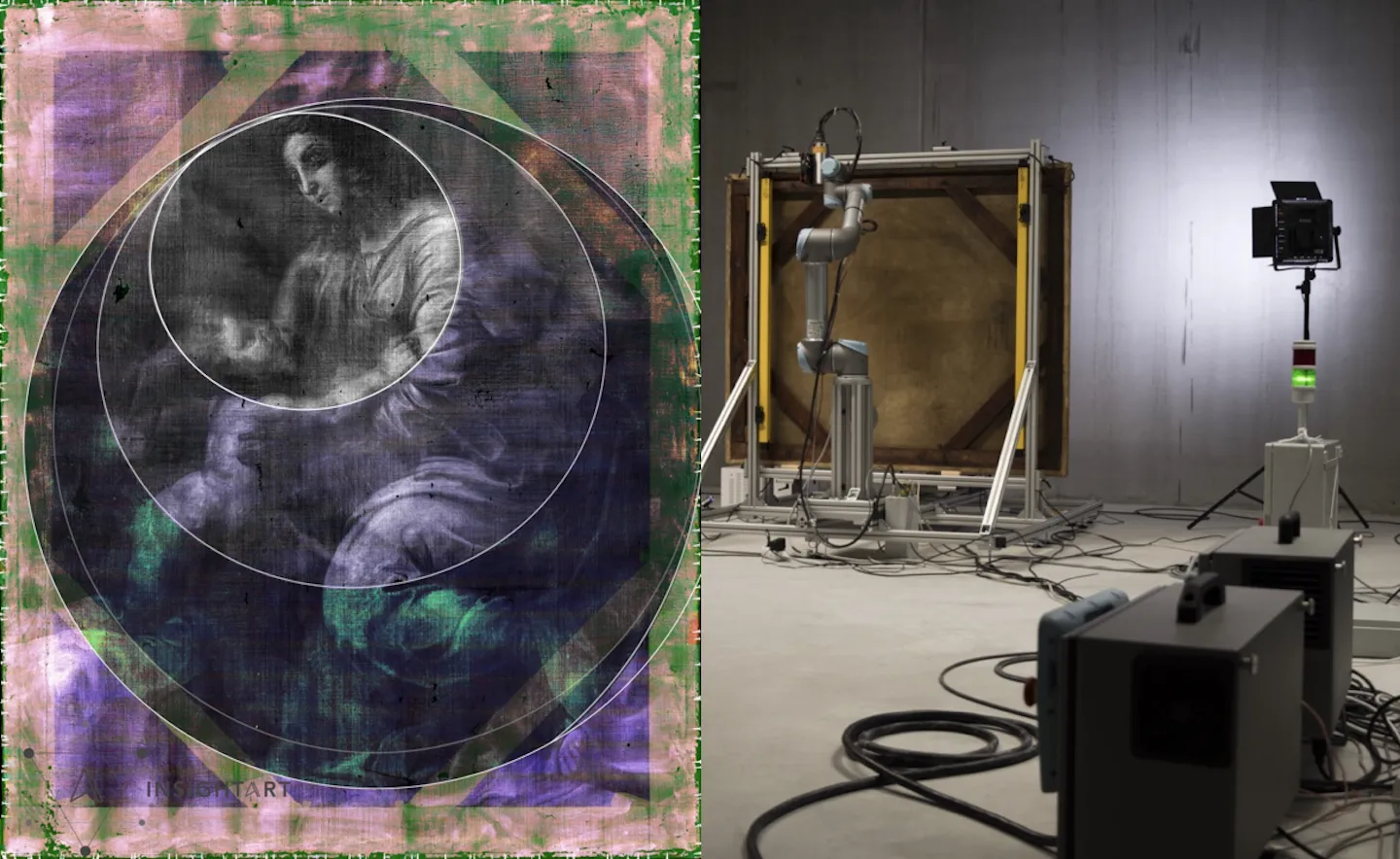
CERN’s Timepix particle detectors, developed by the Medipix2 Collaboration, help unravel the secret of a long-lost painting by the great Renaissance master, Raphael 500 years ago, the Italian painter Raphael passed away, leaving behind him many works of art, paintings, frescoes and engravings. Like his contemporaries Michelangelo and Leonardo da Vinci, Raphael’s work made the…
-
NASA, CERN Timepix Technology Advances Miniaturized Radiation Detection
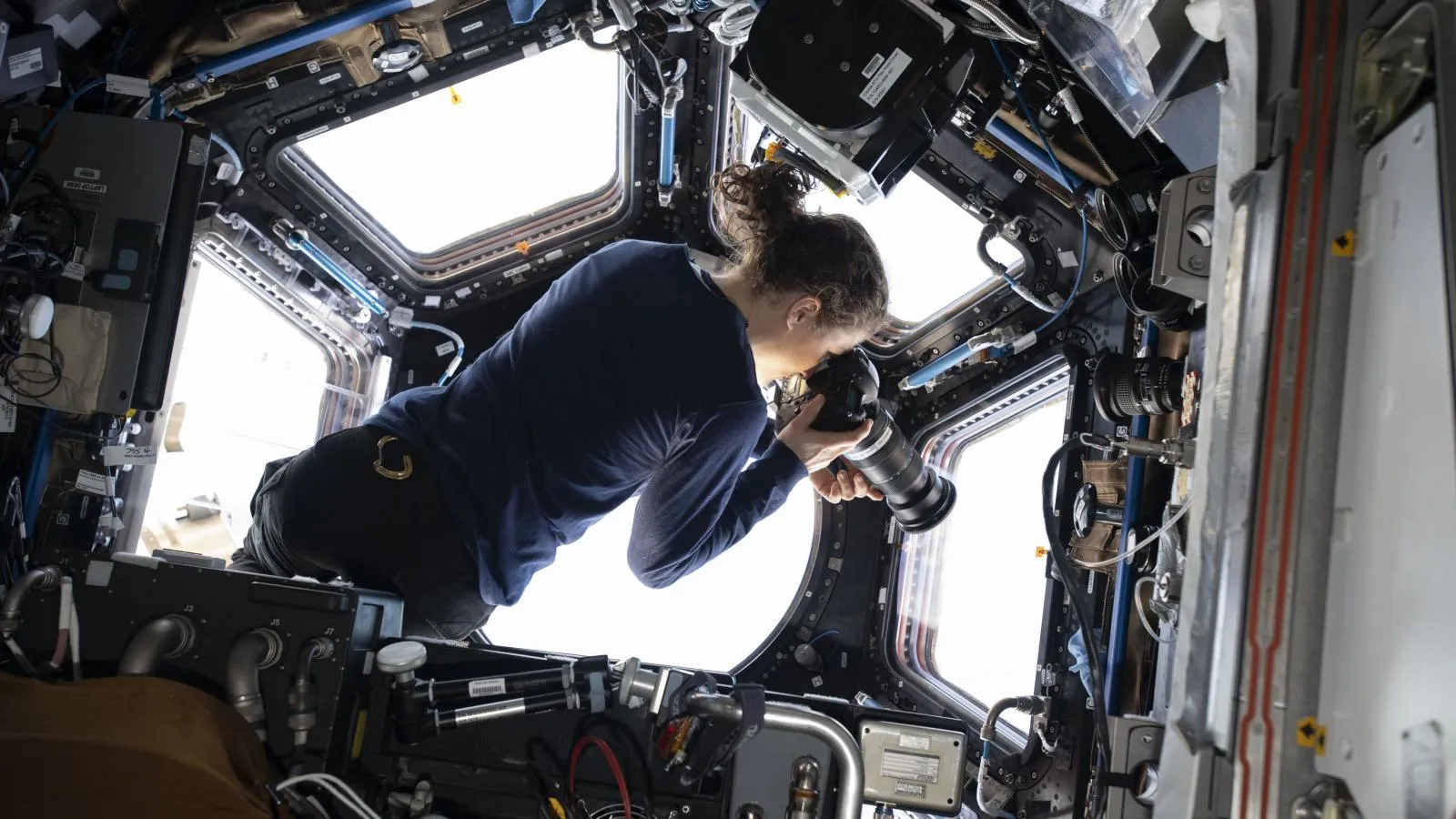
As we prepare to send the first woman and next man to the Moon and on to Mars, NASA, with support from the University of Houston, has been working to develop advanced radiation detectors to better protect astronauts and vital spacecraft systems. As we prepare to send the first woman and next man to the…
-
Amsterdam Scientific Instruments (ASI): Timepix3 licence
Amsterdam Scientific Instruments (ASI) has acquired a license from CERN for the TIMEPIX3 technology, a core component for ASI’s next generation hybrid pixel cameras. Amsterdam Scientific Instruments (ASI) has acquired a license from CERN for the TIMEPIX3 technology, a core component for ASI’s next generation hybrid pixel cameras. With the newly obtained license the company…
-
ADVACAM: Timepix3 licence
CERN as an authorized licensor of Medipix3 collaboration and ADVACAM s.r.o. have signed a Timepix3 license agreement. Timepix3 chip (TPX3) is the next generation of X-ray and radiation imaging technology. CERN as an authorized licensor of Medipix3 collaboration and ADVACAM s.r.o. have signed a Timepix3 license agreement. Timepix3 chip (TPX3) is the next generation of…
-

Schoolboy uses grid computing to analyse satellite data
At just 16, Cal Hewitt, a student at Simon Langton Grammar School for Boys in the United Kingdom became the youngest person to receive grid certification – giving him access to huge grid-computing resources. At just 16, Cal Hewitt, a student at Simon Langton Grammar School for Boys in the United Kingdom became the youngest…
